Training
6 Times the Treadmill Will Save Your Training
Sometimes, treadmill running is actually the smartest choice. From heat and ice, to speedwork and safety, here’s when to ditch the roads and trails.
November 18th, 2025
Hanoi Marathon 2024. Wet is an understatement.
Let’s be real, the treadmill isn’t fun. Treadmills have historically been used as a form of punishment, and it doesn’t feel like things have changed.
But the treadmill can be a godsend in the right situation. There are some situations where running outside isn’t realistic, and a treadmill is a great alternative to maintain your training.
So although I’m absolutely not suggesting you use the treadmill for all of your training (though people do), I am suggesting that it can be a useful tool to maintain training in the right moments.
Here are a few situations where you may want to swap the road or trails for the treadmill.
#1: Reprieve From The Elements
Heat, storms or ice — whatever it may be, there are many situations where running outside is undesirable, unsafe, or simply impossible.
For instance, daytime running in hot and humid places, like South East Asia or the Middle East, is impossible. The heat would tear you apart.
In a situation like this, a treadmill is a great alternative. This is especially relevant for speedwork.
Even if you can run in adverse conditions, as Jack Daniels points out in Daniels' Running Formula, running in hot, windy or cold conditions makes it almost impossible to hit your top-end speed. That means you may be unable to execute the workout as planned.
Beyond the natural elements, sometimes it’s just too chaotic outside to run safely.
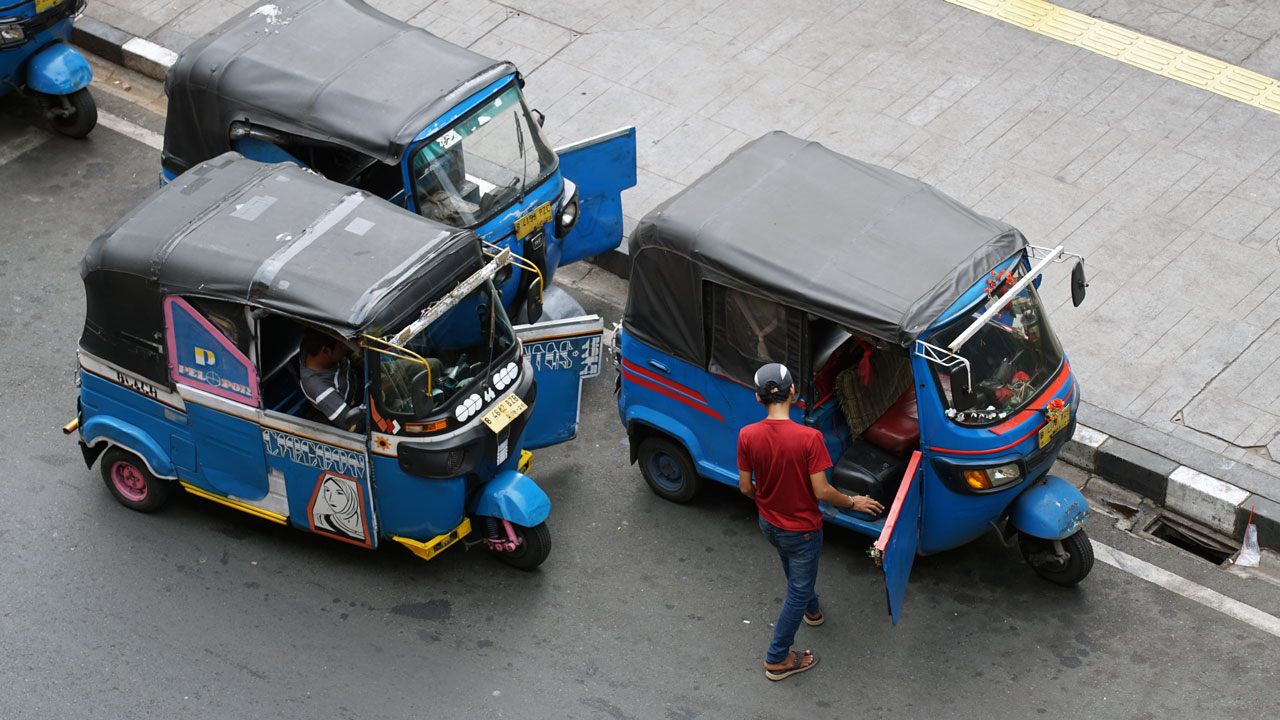
Auto rickshaws in Munnar, India.
If you’ve ever visited India, for example, you’ll know that it’s not a place designed for runners. It’s possible to run, sure, but it’s often unsafe: no pavements, cows, auto rickshaws, motorbikes, people everywhere, and a full symphony of noise. Fun to see, less fun to run in.
(Well, I did race with an auto rickshaw once, though. That was fun).
#2: When There Is No Road
Sometimes, it’s not the elements that hold you back from running, it’s the lack of something to run on.
If you’re travelling on a ship, stuck indoors for whatever reason, or in an area that just isn’t good for running, you may try and avoid those situations entirely.
But quitting your job on an oil tanker or whatever because you can’t run may not be needed.
One thing that used to put me off going on a cruise was going so long without running. Then I learnt that many of them have tracks on the top deck!

Running track on a cruise ship.
But if you don’t have access to a top deck track, the treadmill is a realistic alternative to maintain training without compromising your life decisions.
#3: Controlled Environment for Speedwork
Running outside can be unpredictable. The weather can change, the elevation can vary and something as simple as crossing the road can mess up your session.
For most speedwork sessions, an alternative is the treadmill, which offers a controlled, predictable environment.
You can control the exact speed and elevation, and if you want to hit an exact pace for intervals or a tempo run, you can do that without worrying about battling traffic lights or an unexpected hill breaking your flow.
Though treadmill speedwork is something I rarely do, I’ve found it useful when I have.
That being said, some treadmills don’t go fast enough for many to hit their target speeds, especially when doing more top-end interval work. In this situation, you can add a higher grade to create an overall similar intensity.
But realistically, for the top-gear workouts, you’re better off going at the intended speed on a track or outside on a flat course.
ChatGPT or other AI agents can help you figure out some interesting treadmill workouts to try.
#4: Barefoot Strides
Barefoot running in any form is divisive. But many do believe that there are some benefits to barefoot running in general, and that barefoot running can be incorporated with barefoot strides a few times a week.
While barefoot strides on grass or a very clean track/flat course is possible, many people don’t have access to green spaces, and many don’t want to run on dirty tracks or concrete.
I lived briefly in Phnom Penh, Cambodia. While I loved living there, the city is notorious for lacking green spaces. The roads were covered in debris and traffic, and running barefoot would not only have been miserable, it would have been downright dangerous.

Russian Market. Phnom Penh, Cambodia.
This, I believe, is the case for many urban spaces across the world.
The treadmill is a safe way to incorporate strides without getting your feet dirty.
#5: Hill Sessions Without Downhill
Uphill running is tough, but it’s great for your body. It’s essentially another form of resistance training for your quads, hams, glutes and calves.
But what goes up must come down, and downhill running (while something you may want to explicitly train) is rough on the body, especially your calves and knees — and especially if you have bad form.
Treadmills let you do the uphill segment of a hill session without the downhill part. So if your body needs a break from running downhill, the treadmill could be a great solution.
#6: Quick Access to Toilet
I don’t think there’s much to say here. Anyone who’s ever clenched through the final mile of a long run knows exactly why this matters.
Anyone with IBS or a similar gut issue can easily appreciate the value of having quick access to a toilet. But we’ve all found ourselves on days needing the toilet more than usual.
If you do find yourself in this situation, a treadmill guarantees that you always have easy access, and don’t have to waste time frantically searching for one while out on a run.
So this is the bottom line: nobody is asking you to love the treadmill, but in the right situation at the right time, it can be the key to saving your training.