Training
Why a "Dream Job" Won't Make You a Faster Runner
Think a flexible job is the secret to a 2:45 marathon? It’s not. Learn the pragmatic principles of training for a sub-3 marathon while working a full-time job.
April 11th, 2026
Bataan Half Marathon, November 2024.
Last year, I ran a 2:45 marathon. I had a remote desk job and plenty of flexibility to train.
On paper, that’s the dream scenario for training, right?
But that’s not the full story.
I’ve also trained in far more difficult situations.
I ran a 3:08 marathon and consistent 17-minute 5Ks while working 50+ hours a week as a chef — on my feet all day.
And I spent months travelling through Asia — training in heat, humidity, and constantly changing environments — still managing a sub-3 marathon in Bangkok.
So yes, a flexible job helped. But it wasn’t the reason I ran that time.
The reason was simple: I made running a priority, and I always found a way to make it work.
The conditions were rarely perfect, but I always adapted.
And so can you.
In this article, we’ll look at the principles that I use to become a faster and stronger runner year-on-year when conditions aren’t great, as well as practical advice to find time for, and optimise, your training, no matter what your life looks like.
Is it worth it?
Before looking at the principles, it’s worth saying this upfront: training properly for a marathon (or any serious running goal) is not easy.
There is a reason that times like the sub 3-hour marathon are so elusive. You have to work for them.
And the faster you get, the more work you need to do.
So before you commit, you need to ask an honest question: is this going to be worth it for me?
Because when you start taking anything seriously — whether it’s running, or starting a youtube channel, or whatever — it requires sacrifice.
You might have to spend time away from family to do long runs, accept being a little more tired at work, or give up drinking at social events.
For example, I’ve had a friend’s stag recently and I was (mostly) teetotal. It was a sacrifice I deemed worth it as alcohol impacts my sleep (essential for recovery, of course). I got rinsed for it by other people there, and even a little pressured. But again, for me, it was worth it.
In my eyes, when you commit to running these kind of times, you’re basically committing to a lifestyle that requires sacrifice, but also consistency, grit, and a healthy approach to mind and body.
So, again, ask yourself: is this, truly, what I want?
Core Principles
#1: Make a Plan
If you have a goal — whether a sub-3 marathon or your first 5K — you should absolutely make a plan to achieve it.
Your plan could include detailed sessions every day, as well as cross-training, workouts, stretching, and so on.
But even if that plan is as basic as “I will run 3 days a week” — that’s something.
(I lean more into the former, but I’m a bit of a type-A person).
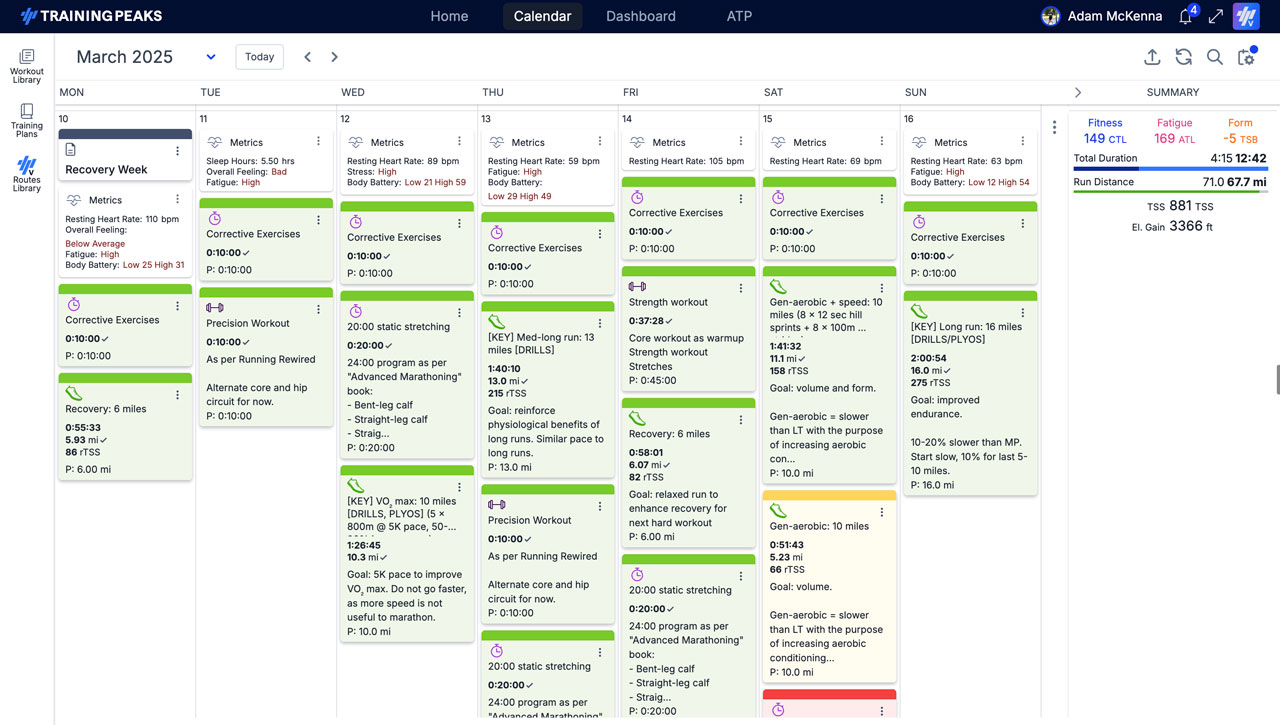
A typical week during peak training. Screenshot from TrainingPeaks.
Whatever you decide, don’t rely on “vibes” and “seeing how you feel” — because most of the time when it comes down to it, let’s be honest, you can’t be arsed.
You need at least some guidance to achieve your goal.
#2: Perfection is the Enemy of Good
But — and I cannot stress this enough — the plan is not gospel. Be willing to tear it up if you need to.
If for whatever reason, you can’t stick to your original plan, find a compromise. You can still do something.
For example:
If you’re too exhausted to run a speed session, do an easy session instead.
If the weather is terrible, try and find a treadmill.
If your legs are tired, go to the gym or get on the yoga mat.
It’s all about your head. When you start thinking that things aren’t worth doing unless they’re perfect, things get dangerous. That’s how a lot of people fail. This is exacerbated by social media posts showing perfect workouts and so on.
But that’s not how real life works. Life has challenges and distractions. And when they hit, most of the time, "good enough" has to do.
A compromise session keeps you moving, while a skipped session does nothing.
#3: Pragmatism is King
If there’s one mindset, one principle, that ties all of this together, it’s this: be pragmatic.
I believe this is one of the best attributes a person can have. In a similar vein to the previous point, striving for perfection is great, but life is rarely perfect. Sometimes “good enough” has to do.
Look at your situation and think: how can you incorporate your training in a way that is pragmatic with your lifestyle?
Forget about what the running gurus on YouTube tell you is perfect, and think about what the options in front of you are.
When travelling around Asia, it was often chaotic. The heat and humidity was tough, the roads often weren’t great, or there’d be wild dogs or monkeys around. But I’d always find a way to get my training in.
For instance, one time in Malaysia, we were camping on the edge of a beach. There was a single road in and out of the area. I headed out for a run, and on that day, the most ripped monkey you’ve ever seen happened to be guarding the road.
I wasn’t chancing it — no way. But I wasn’t giving up either.
I couldn’t get onto the main road, but there was a short loop around the beach on a rough dirt trail. So I did that over and over, instead. The same distance, just a little more cumbersome than a paved road. Not ideal, but it worked.
That is pragmatism. It's about using the tools you actually have:
If you don’t have a track near you, use the flattest loop you have nearby.
It’ll probably do just as well.
If you don’t have any gym equipment, find some heavy stuff and use that.
A backpack full of books, or a heavy plant pot, for instance.
If you want to get in some heat adaptation but can’t go somewhere hot, use alternative methods.
Practical Tips
Those are the high-level principles that I keep in mind as I move through my training — especially when I’m travelling or conditions aren’t perfect.
But, of course, I’ve picked up a few practical lessons on the way that I wanna share.
Lifestyle Integration
Merge your tasks: When I was working as a chef, the kitchen was a perfect 5K from my house. I could have driven, but I merged my commute and run together. 5K there, and a very hilly 5K home. 10K a day, and a free commute.
Use the "cracks" in the day: There’s always cracks in the day to fit in something. For me, that means working out while on passive work calls or watching TV, stretching while waiting for the bus, or squeezing in runs during my lunch break.
Let go of social norms: Stretching at a bus stop or working out at an airport might look weird. But it isn’t. You’ll get some weird looks for a moment, and then they’ll go back to staring at their phone or whatever. Meanwhile, you’ll be moving the needle forward.
Training Adaptations
Adapt to the environment: I already mentioned the monkey story. In a similar vein, I was staying with a friend in Andorra. It’s nothing but hills there. Fine — I just adapted my sessions to be either way slower, or to embrace the hills. Just because I couldn’t run to the plan, doesn’t mean I couldn’t use it to my favour.
Get creative with gear: We’ve already mentioned these, but if you don’t have a track, use the flattest loop you have. If you don’t have gym equipment, find some heavy stuff—a backpack full of books or a heavy plant pot.
Double days: Running twice a day is not only possible, but for many people, preferred. Breaking a 12-miler into two 6-milers still gives you the aerobic volume but significantly reduces the mechanical loading and injury risk when you're already fatigued from work. It’s also good for metabolism.
Adjust based on your fatigue: being on my feet all day as a chef meant my legs were always pretty tired. My quality workouts remained the same, but I adjusted my easy runs to a slower pace to ensure I didn’t burnout.
If there’s one thing to take away, it’s this: you don’t need perfect conditions to improve as a runner.
Be pragmatic and accept “good enough” and you can go a long way.
Anyone who watches this channel knows I think social media can be dangerous. But people only show the perfect on Instagram. They rarely show you these sorts of logistical challenges that us “normal” people have to face.
It’s not just me, by the way: a coach at my running club, for example, ran a sub 2:30 marathon working a labour job. It’s not impossible at all to do this with a job that isn’t at a desk. You may just have to get creative.
There’s, of course, way more to running and training than what I’ve covered here, but this is purely looking at how to train consistently and well in spite of unfavourable conditions.
There’s good recovery, sleep, solid training plans and a bunch of other things to consider — for instance, running slow — which you can learn more about in this article.