Training
Running Hot: The Science of Heat Adaptation for Endurance Performance
Training in the heat has been proven to improve performance in running races. But can you do heat adaptation training without travelling abroad? Find out in this article.
September 29th, 2025
Racing in hot and humid Batu Pahat, June 2024.
Marathons are being raced in hotter conditions than ever. At the London, Berlin and Manchester marathons this year, runners suffered intense heat.
The heat is no joke, especially if you’re not used to it. A friend, an experienced ultramarathon runner, collapsed 20 miles into the Manchester race this year due to the heat.
As the world heats up, being able to withstand running in the heat is becoming ever more relevant.
It is well-documented that consistently training in the heat — a process known as Heat Adaptation (HA) — improves performance when racing in hot conditions.
More interestingly, these benefits may transfer to cool conditions, too — similar to altitude training. In other words, heat adaptation may make you faster when you come back to cool conditions. But unlike altitude, you don’t need a trip to Kenya or Flagstaff to benefit.
Despite the benefits of HA, it seems to be an untapped market. In this article, we’ll explore the benefits of HA — both the science and my personal experience — and explain how you can do it — potentially, without travelling to a hot country.
What is HA?
Heat adaptation (HA) is simply training — or even just existing — in hot or humid environments to force physiological changes that make you faster.
Heat adaptation is associated with a bunch of physiological benefits, including:
Increased plasma volume.
Lower HR at submax effort.
Improved sweating response.
Better thermal comfort and tolerance.
One study, for instance, found a 6% increase in time-trial performance in cyclists after 10 days acclimatising to the heat.
Until recently, I understood “heat adaptation” to mean “run in the blazing sun until burnt to a crisp.”
But that’s not what the science says:
It’s not about the sun, nor how hot it is — it’s about how hot you get (your core temperature).
You can mimic “heat” by overdressing, running in a heated gym and so on.
Mimicking heat is also safer because you can dose the heat without direct sunstroke risk (I’ve been there — it’s not fun).
In fact, science says that you can achieve heat adaptation without running in the heat at all (more on that later).
Personal Experience
Before reading the science, personal experience had demonstrated that there is value in training in the heat. I lived in Southeast Asia for 9 months. The weather is hot all year round, and the humidity is usually around 80-90%.
Though training in these conditions was tough, my race times gradually improved.
Then, when I returned to the UK at the end of last year, I set a new personal record in every distance I cared about. It became clear to me that, among other factors, the exposure to heat and humidity had boosted my fitness.
This exposure helped, as we Europeans were hit by one of the hottest springs on record, leading to the aforementioned scorching hot London and Manchester marathons.
I didn’t race either, but instead opted for the (slightly obscure) Leiden Marathon a few weeks later in May. The conditions were even hotter. The temperature had hit 32 °C when I crossed the finish line.
Yet I felt okay. It was uncomfortable, sure. But I didn’t need to stop or adjust. And I wouldn’t collapse. It’s hard to say whether the benefits were physical, physiological, or both. Whatever the case, my exposure to the heat in Southeast Asia made the exceptional heat of Leiden feel normal.
Running consistently in the heat had taught me to learn how my body feels in the heat, to know how far I can push, and to feel confident that I can make it over the finish line without collapsing.
The Science
My personal experience is just anecdotes. But the science says a lot of the same.
Athletic Performance Is Improved With Heat
One meta-analysis that reviewed the impact of HA on a bunch of different metrics, such as time-trial performance and heart rate, concluded that:
“Athletic performance is improved with heat [adaptation] training.”
HA offers a flurry of physiological improvements (see below), though it’s not entirely clear which improvements lead directly to improved performance.
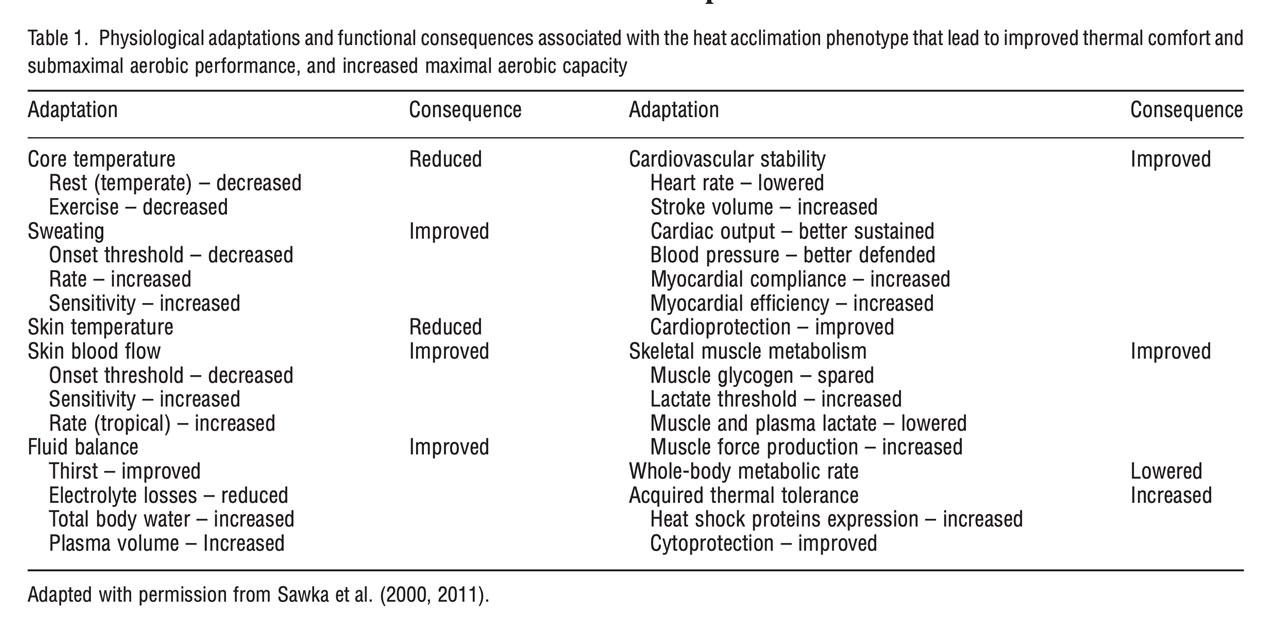
The physiological adaptations of HA. Source: https://pubmed.ncbi.nlm.nih.gov/25943654/
Interestingly, most of the studies reviewed had their athletes train at low intensities. The reason is that heat and humidity lead to “premature fatigue and loss of performance” and make it difficult to train at max effort.
It is difficult to execute high-intensity sessions (think intervals and fartleks) properly in hot/humid conditions, which leads to lower quality training. Instead, easy efforts (recovery, steady or long runs) should be run when doing HA, with high-quality sessions run in cooler conditions where possible.
The Cool-Weather Carryover
While this meta-analysis focused mainly on the benefits of HA when performing in the heat, one of the studies they reviewed also examined whether the benefits translated to cool conditions. They found that it does.
Cyclists did 7 moderate heat sessions. Both they and a control group did time trials before and after.
The heat group demonstrated an 8% improvement in hot conditions and a 6% improvement in cool conditions. They also found beneficial changes in VO2 max, resting core temperature, heart rate, and more.
The research exploring the benefits of HA when performing in cool conditions is limited, but it’s exciting and promising.
You May Not Even Need To Exercise In The Heat
As mentioned, you might not need to run in the heat at all.
When exposed to hot and/or humid conditions for prolonged periods, your body adapts. In particular, your blood volume increases.
One study explored the impact of time in the sauna on sub-elite endurance athletes’ performance.
They found that endurance athletes who sat in a sauna (around 89 °C) for 30 minutes immediately after training, 12 times over 3 weeks, saw a 1.9% improvement in their 5K time — probably due to increased blood volume.
The study concluded that elite athletes would probably see smaller benefits, implying that less advanced runners may see even larger benefits.
In other words, the sauna may lead to a larger than 2% improvement in your 5K time. In theory, that would bring a 20-minute 5K finish time down to 19:36.
Though untested, I reckon other hot environments — like hot yoga — may offer similar benefits. While the ambient temperature at hot yoga is lower than the sauna, your core body temperature increases from the physical exertion of yoga and may lead to a similar body temperature.
While the sauna study is well-documented, the idea that hot yoga might work similarly is still untested.
Though logically, if you can get your core temperature consistently higher — whether through being in a hotter country or a sauna, or even through running with extra layers — you’ll (theoretically) see physiological benefits.
All that being said, while you can certainly see gains from this passive exposure to heat, you’re not going to see as much benefit as actively exercising in the heat.
Another meta-analysis on heat adaptation concluded:
“Although exercise in the heat is the most effective method for developing heat [adaptation], passive heat exposure also results in some adaptation. However, the specificity of exercise environmental adaptation lies with the stimulus representing the conditions in which the athlete will eventually perform. Thus, to achieve optimal adaptation, work rate and environmental conditions should closely replicate those of the competition setting.”
In other words, it’s all about the principle of specificity: you want to emulate the situation that you’re training for as closely as possible. That means running in the heat, especially if the event you’re training for will be hot.
How Long Should You Train In The Heat?
Studies have demonstrated that to gain the optimal benefits from heat adaptation, you need around 2 weeks of exposure. However, you can gain benefits from as few as 4 days.
This chart shows the benefits you might expect over a given period of time:
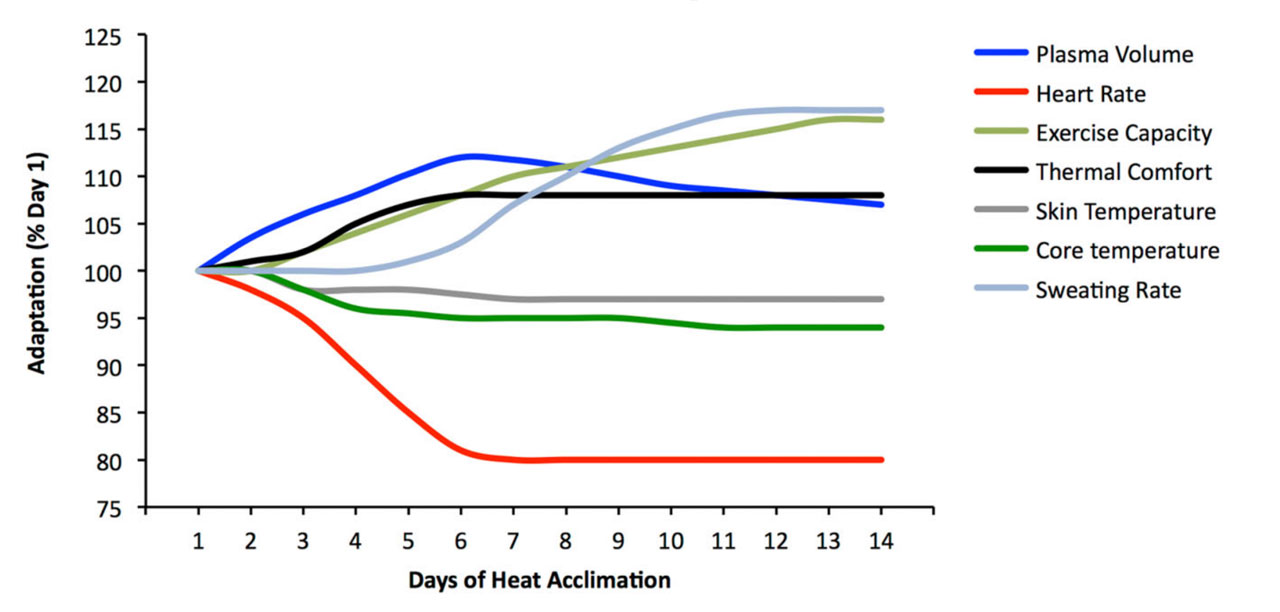
Timeline of physical adaptations in HA. Source: https://pubmed.ncbi.nlm.nih.gov/25943654/
Practical Takeaways
How long to train? 2 weeks = optimal. 4 days = still benefits.
Low intensity is enough. Don’t kill yourself in the heat. Avoid doing harder sessions in the heat if possible as this may reduce the quality of the session.
There are many ways to HA — it’s all about core temperature. Opt for the treadmill with extra layers, saunas and hot yoga, or simply spending time in hot and/or humid climates (e.g. Spain, South East Asia, etc).
Don’t overdo it. Don’t spend too much time in the direct sun. Listen for signs of dehydration, dizziness, or heat illness. Drink lots of water and electrolytes.
Conclusion
Altitude training has long been the holy grail of performance gains. But for most runners, it’s inaccessible.
Heat adaptation offers a surprisingly powerful — and much more practical — alternative.
Whether that means a sauna after your long run, a few sessions overdressed on the treadmill, or even a training block in Spain, heat could be the secret weapon that takes your racing to the next level.