Training
Why Every Runner Needs a Running Club
Anyone, regardless of running ability or level of interest, should join a running club to improve both their running and general health.
September 17th, 2025
Phnom Penh Athletics Club, November 2024
Joining a running club is an incredible life hack.
Running clubs can make you faster, help you live longer (really) and are a lot of fun.
I firmly believe that anyone — regardless of your age, ability or how new you are to the sport — should unquestionably join a running club.
Where Do I Sign Up?
Before we dive into the many benefits that running clubs provide, let’s take a quick look at what options you have. The benefits you can gain from a running club hinge on the type of club you join.
Since the easing of lockdown, there has been a surge in running clubs — at least in Europe. In my local area, new clubs are constantly popping up.
With so many choices, the challenge isn’t finding a club; it’s deciding which club to join.
In my view, clubs can be categorised as either traditional clubs or ”Instagram” clubs.
Traditional clubs are more established. These are the sort of clubs that were established while Queen Victoria sat on the throne. My first club, for instance, was founded in 1890.
They typically organise weekly training sessions, coaches and club races, as well as the chance to compete with other clubs in races.
While such clubs often have a subscription fee, the fee usually covers your participation in races, gear (e.g. club vests) and social events. Quality can vary, but these clubs generally operate at a high standard.
In the case of “Instagram” clubs, some focus on performance (think: hyper-organised sessions with breakout groups based on ability), whereas others focus on looking good (think: a social plod while everyone films reels of themselves).
Even so, Instagram clubs often offer real value. These clubs are often more approachable and casual than the traditional clubs, and generally free — though you probably won’t be able to take part in club races.
I don’t think that one type of club is inherently better than the other. It’s simply about running with other people — the rest is just flavour. (More on how you can make any session work for you later).
Finding a club is straightforward enough: ask other running friends or people at the Parkrun or races, check Strava or Instagram or simply Google it.
The process can be like dating — if you don’t like it, try another one. And there’s nothing wrong with trying out multiple clubs at the same time.
Many clubs also run women-only sessions or operate exclusively for women, which can make joining feel more comfortable.
Paid clubs will generally let you try a session or two for free before you commit, whereas others are totally free. So you’ve got nothing to lose.
Competitive? Sign Up.
If you’re competitive, joining a running club may be the single best thing you can do for your speed.
Here’s why:
1. Exposure To Speed
Club runs are most often structured as speedwork sessions. For runners new to structured speedwork, these sessions can be transformative.
While running mostly slowly is important, club speedwork gives you the intensity you need to get faster.
Clubs also offer sessions you simply can’t do alone.
With an old club, we regularly ran a session called the “Killi pursuit” (so named because it took place in a town called Killingworth).
The idea was simple:
Get a group of 5-8 evenly matched runners. Run a 5-6 mile tempo session, with each runner lined up one-behind-another.
Throughout the session, the runner at the back of the line sprints to the front of the group. Then the next. And so on.
Such sessions are a novel way to add surges to a tempo run — and they’re a lot of fun.
2. Running With Others Makes You Faster
Humans are cooperative by nature. When we work together, we are capable of doing more and doing it better. This phenomenon is called the group effect.
So it goes with running. Whether racing in a time-trial or grinding intervals, running will feel easier, and you’ll be able to run harder when training in a group.
As Matt Fitzgerald writes in How Bad Do You Want It?, when people train together their brains release more endorphins. These endorphins reduce our perception of effort, making the run feel easier.
3. Attend Club Races and Break Records
Clubs (especially traditional clubs) often host races and offer group participation in regional cross-country and relay races.
Racing alongside your clubmates can spur the group effect. You will probably get another boost from the club spectators, too. When people are being watched and expectations are set, they often perform better to try to match those expectations. This phenomenon is called the audience effect.

Cross-country. Not my cup of tea.
For those who are particularly competitive, many clubs have historic records that were often set decades ago and are waiting to be broken. With major increases in technology — from optimised gels to super-shoes — races are only getting faster. Perhaps you could get your name on a plaque in a clubhouse somewhere.
Even If You’re NOT Competitive, You Should STILL Sign Up
If you don’t run competitively, there are still benefits to running in a club.
Running clubs are very inclusive. I’ve run with people from all walks of life, of all ages, genders and running experience.
It’s not just about performance. Running clubs are fun, encouraging and give you a sense of camaraderie, regardless of your running goals.
Eat The Miles Away
Regardless of your level, you need to get volume in. Running in a social context eats away the miles.
When running with clubmates, you get into a conversation and then, before you know it, you’ve covered 4 miles. Even the speedwork flies by.
Benefits Outside of Running
Running clubs are fantastic social environments. While you meet on the track, you often build relationships that extend into regular life. As mentioned, being part of a community or club has been correlated with a longer life.
Even if you have no running goals — which is fine — being part of a running club is great for both your physical and mental health.
Makes Travel More Fun
This is a slight aside, but one of the benefits of accessible running clubs is that they’re a great way to get grounded in a new place.
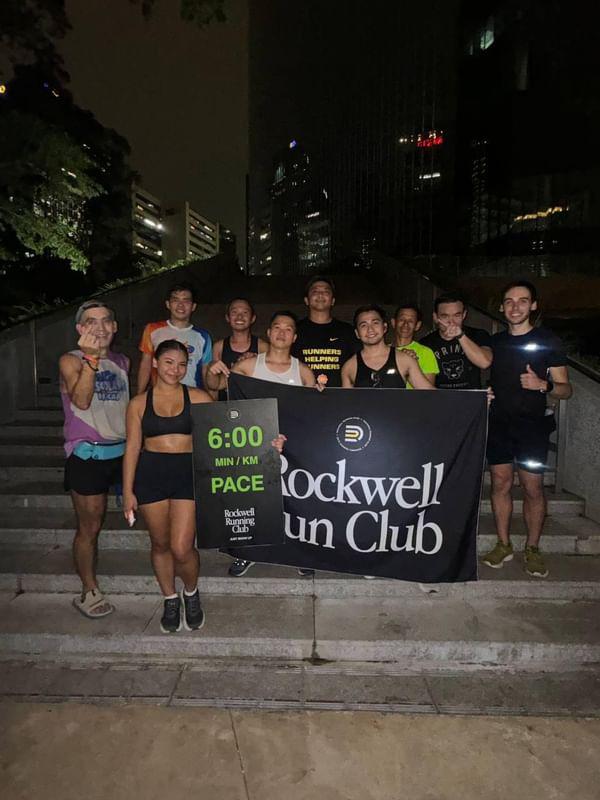
Rockwell Run Club, Oct 2024. I tagged along while visiting Manila, Philippines.
If you’re visiting a new city, joining a running club as a guest is an ideal way to get your training in, explore the city and meet new people.
The Challenges
Running clubs aren’t perfect by any means, and there are some drawbacks that you might want to consider, depending on your goals.
Not All Sessions Are Good
As mentioned before, quality can vary between clubs. Some clubs offer dedicated coaches and sessions with proper warmups, drills and strides and tailored feedback. Other clubs can feel like a disorganised free-for-all.
Aim to join the best-quality club you can. But if you only have the option of a poorly organised session, it’s still worth joining — there are benefits to running in any club.
To make this work, you need to understand and prioritise your running goals. You should aim to gain the benefits of running with others without compromising the quality of your training.
For instance, if a session is just a mass plod, make that a recovery run. You get the social benefits of running with others and execute your intended session. Or if the club doesn’t offer a proper warm-up with drills and strides, do them by yourself beforehand.
May Be TOO Competitive
Some clubs may be too competitive — or, more specifically, may have members who are too competitive.
For competitive runners, it’s easy to get swept up in an ever-increasing intensity that leads you to push too hard and overtrain.
For instance, if runners in the club push the speed of a session beyond the plan or add distance that takes you beyond your goals, you might be tempted to try to keep up for the sake of ego.
But that is usually a mistake. You have your own goals, which you should try and stick to. If others push beyond what you plan to do, you shouldn’t aimlessly try to match. You should try (hard as it may be!) to let go of your ego and stick to your plan. You’ll be better off in the long term.
I’ve fallen into that trap. It led to shin splints, which took a while to shake off. Not worth it! Don’t try to run someone else’s training block. Stick to your own plan and focus on yourself, not what others are doing.
So, What Are You Waiting For?
Whether you’re joining a 150-year-old Harriers club or an Instagram group that started 5 days ago, you’re guaranteed to get something out of it — as long as you're mindful of your own goals.
Worst case, you log a run. Best case, you gain new friends, countless fun sessions, and maybe even a PR.
So go ahead: Google a club near you, drop in for a session, and see what happens.