Essay
The Berlin/Prague SuperHalfs Scandal and the Gamification of Running
Is gamification ruining running? We explore how Strava, Instagram, and medal series like the SuperHalfs are reshaping runner motivation. We dive into extrinsic vs. intrinsic rewards and the physiological cost of chasing "digital badges" over performance.
April 14th, 2026
Focused athlete. Runthrough Quayside 10K, January 2026.
I’ve been asking myself a question recently: why are we actually running?
Because something about running culture right now feels off.
It’s starting to feel less about the running itself and more about the fluff around it: the social media posts, the ticked boxes, and the medals.
(And by the way, yes, the irony of me making a social media post about this is not lost on me).
A few weeks ago, the SuperHalfs had two races on the same weekend — Prague and Berlin. And despite the logistical nightmare, people ran both.
I wonder: if these races weren’t part of the SuperHalf series, would anyone have ever done that?
But add a collectible at the end and a social media post opportunity, and suddenly people are willing to go way above and beyond.
So, what’s actually driving this?
The Gamification of Running, and Social Media
What we’re seeing here is something called gamification.
Gamification is just adding game-like elements — stats, leaderboards, achievements, whatever — to make something more engaging.
These elements create an extrinsic motivation. You do it to improve stats or climb the leaderboard. The opposite would be an intrinsic motivation — you run for its own sake.
Strava — with its streaks, stats and kudos — is the perfect example.
“If it’s not on Strava, it doesn’t count.”
People don’t run just to run — no, they run to post that they’ve run.
Other social media like Instagram takes everything a step further. It turns running into a performance — and not the athletic kind.
A run is no longer something you just do — it’s something you present. A race isn’t about the race anymore, it’s about the photos and the “story” around it.
Things become less about how the run “feels” and more about how it looks online.
It creates this new dimension to running, where the experience gets filtered through how it’ll be perceived afterwards.
I wonder: when you’re racing, are you enjoying the moment, or are you already thinking about how to frame it online?
Because this mindset begins to shape all running decisions: what you do, where you run and whether a run even “counts.”
It’s a feedback loop, and suddenly before you realise it, you’re only running to post your runs and races on Strava and Instagram.
And while these apps shape daily decision making, the same logic scales up in a more obvious way through races and medals.
Medals
The World Marathon Majors is a cornerstone of the running community. Every year, thousands line up at seven of the biggest marathons in the world.
And for many people, they’re there for one single reason: the 6-star medal.
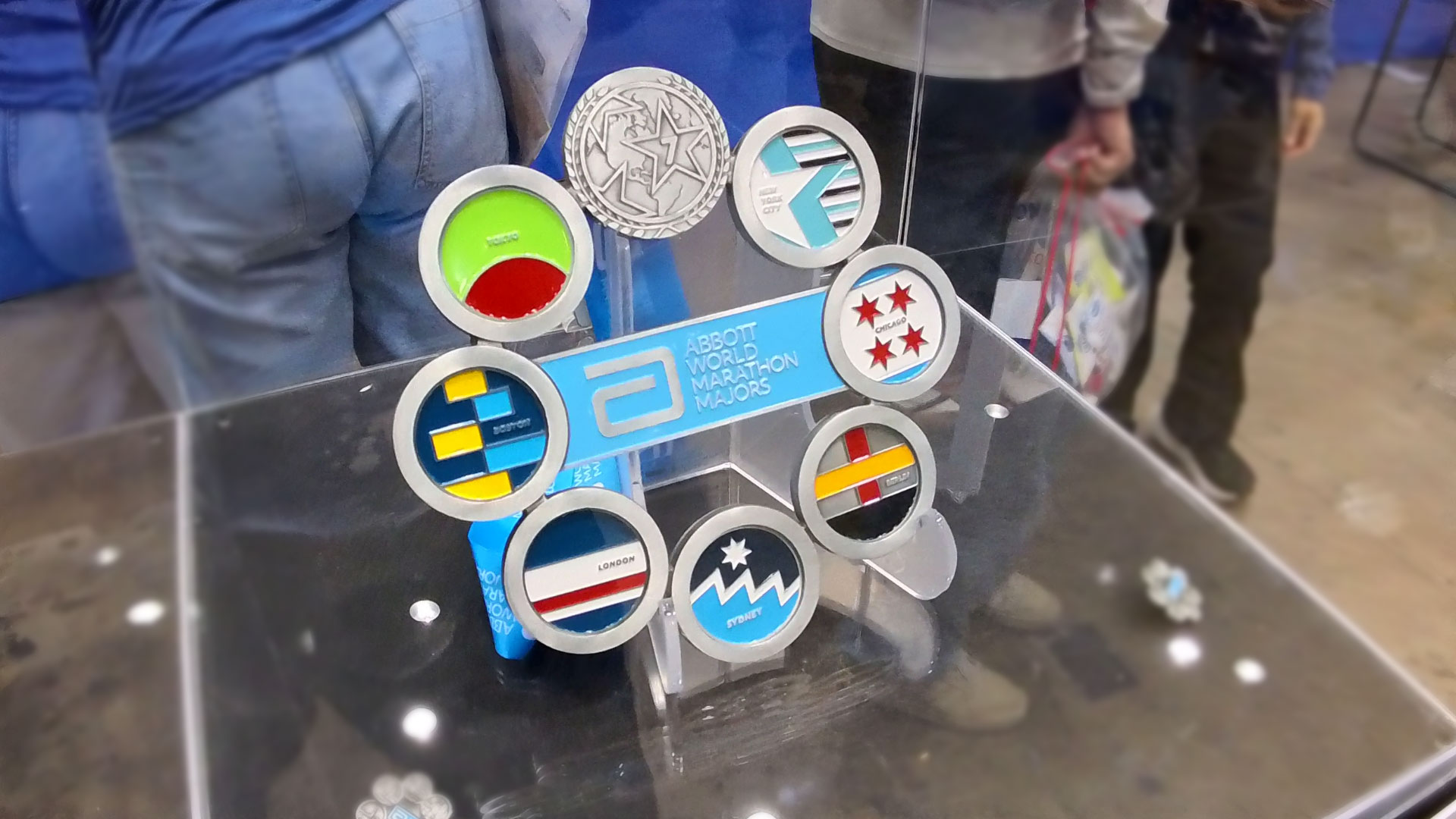
Abbott World Marathon Majors 7-Star Medal.
Run all six, get a special prize at the end. It’s a piece of marketing genius.
This simple idea has pushed people to fly across continents and spend thousands of pounds completing the set.
And the same pattern shows up with the SuperHalfs.
6 half marathons across 5 beautiful cities in Europe, and… checks notes... Cardiff.
This year, they even scheduled two races in the same weekend — Prague and Berlin — and people ran both.
From both a travel and performance perspective, it doesn’t really make sense.
To do both, runners would have to:
Sign up for both.
Travel multiple times between cities in a matter of days to collect bibs and race.
Race back-to-back across a weekend.
And if you’re running two half-marathons in a single weekend, you’re probably not racing both properly.
In fact, for many runners, it could even be dangerous. Half-marathons take a huge physiological toll, and racing two back to back is not only means a poor time, it also means a potential injury.
So, if it’s not about travel or performance, what is the point?
Well, take away the medal and the social media posts — would you still do it?
Pros and cons of gamification
Don’t get me wrong, I don’t think the gamification of running is an inherently good or bad thing.
If you enjoy collecting medals or tracking stats or whatever motivates you — that’s great.
And there are real benefits, too.
It encourages more people to run, helps build habits and consistency, and pushes people toward a healthier lifestyle long-term.
But the flip-side is that gamification — especially when tied to social media — makes us more vulnerable to marketing and some of the traps that come with it: image issues, validation, and tying self-worth to posts about runs and races.
Suddenly, our self-worth gets tangled up in Strava posts or medals on a shelf.
And that begins to inform our decision making.
Will you skip runs if you can’t post them?
Will you avoid things that would help you improve just because they don’t get shared on social media?
Will you stop showing up if there’s no medal attached?
Does your identity as a runner hinge on gamification and social media?
Personal stance
My personal view is a bit cloudy. As I said, I don’t think any of this is inherently good or bad, but it absolutely shapes why we run more than we think.
To be honest, I don’t care much about medals. I’m not really a fan of collecting them, and I don’t think running purely for that reason adds much value for me.
That said, I am running the SuperHalfs and World Marathon Major series, but more because they’re well-organised, high-quality races than because of the medal at the end. The medal is almost incidental for me, to be honest.
Or maybe I’m a “victim” of gamification and I don’t even realise it.
Strava, that’s different. I 100% get that side of it. Posting runs gives me a small sense of accountability, and it helps me stay consistent.
Social media, though, is a tricky beast. I think social media is dangerous. I make a conscious effort to avoid posting and tying up my self-worth with likes and comments. Well, except for YouTube. Like I said, the irony isn’t lost on me.
But I am on Instagram, and I’ve talked in another post about the pros of social media as athletes.
The critical difference is that I am being mindful of how I use it. Social media is a great servant, but a cruel master.
So all in all, I do lean into most of these gamifications to some extent — even the ones I’m questioning.
I don’t think the issue is social media or medals themselves.
It’s when they subtly become the reason you run, instead of a bonus.
And maybe that’s the real question here: it’s less about whether gamification is good or bad, and more about how much social media and medals are reshaping your motivation to run without you even noticing.
Are you running for the experience, or because you want to post about the experience on Instagram? Are you running for performance, or because of how impressive your time looks on Strava?
For many of us, gamification has metamorphosed from a reward into the reason we run.
Because it’s easy to say “I just like running”, but it’s worth asking what happens if you take everything away — social media, the medals, the tracking. Are you still having fun?.